I am stunned that this semester alone, there are over 6.7 million students in the USA alone who are undertaking some form of University study - ALL ON-LINE!
On-line learning is becoming such an integral part of the mix when it comes to learning and developing new skills - we consider it almost a norm compared to where we were even a couple of years ago.
The Universities are slowly moving in to the market with their MOOC's -
Massive
Open Online Courses.
This is a new approach to distance learning aimed at large-scale
participation and open access via the
web. The keyword here is open. These courses form part of a large program and
are offered openly to everyone who is keen to extend their knowledge and learn
new skills.
And so, why not introduce this formula for vocational training so that participants all over Australia are able to learn and extend their body of knowledge - at no charge!
We are not Australia's most innovative training company for no reason - so, we are going to give this a go.
Please join our experiment and give us feedback.
We have selected a range of qualification programs that we deliver via virtual learning: a combination of live webinar and ecampus attendance.
Participants will be able to complete the first unit of each of these programs at no charge and with no obligation to continue. They will gain the skills, knowledge, input and information that they need to improve in their job roles.
Should they decide that they do in fact want more and want to gain a full qualification, this is when they will pay the enrolment fees.
I firmly believe that learning opens so many doors of opportunity for those who are determined to move up in their careers or who want to upskill to higher levels. The old adage that 'no one can take your education away from you' now has an opportunity to be put in to practice - and it is available to anyone who seeks self-improvement, additional tools and strategies and more information to perform at higher levels.
Tuesday, January 22, 2013
Monday, December 10, 2012
HR Provider of the year - lessons learnt!
What a
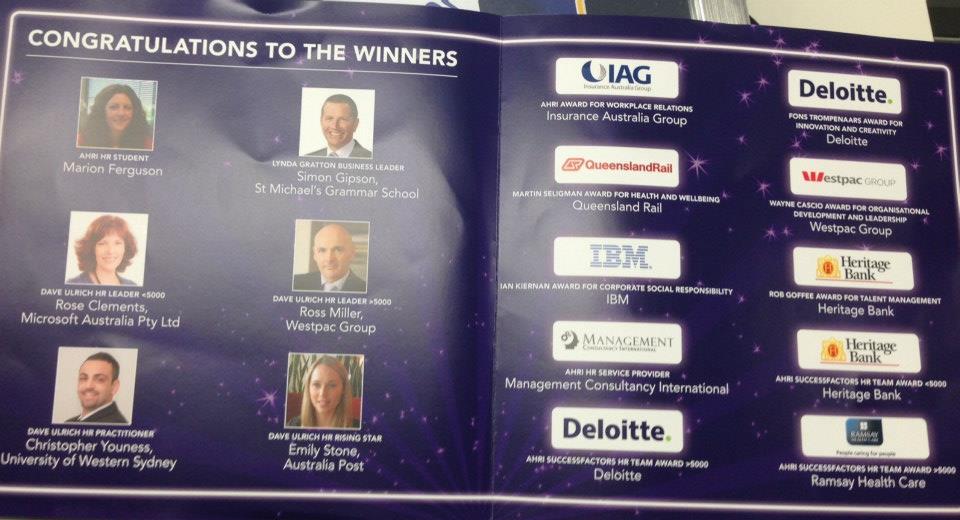
marvellous way to end the MCI year! We were named as AHRI HR provider of the
year in the inaugural year of this award. The Judges appreciated our
level of customisation and the standard of our customer service.
Oh
boy...did we learn a few lessons along the way!
LESSON 1. Never be afraid to punch above your
weight!
We walked in to the awards evening at Darling Harbour with 600
other people representing the top brands in Australia including Microsoft,
Deloitte, the Australian Navy, the Department of Immigration, IAG and
more... We thought that there was no way that our small business could
compete in the A League and so we decided to just have a good evening.
When we saw that we were positioned at the back of the room, in the corner,
near the exit, I was even more convinced that we had no chance.
Well, when they announced the MCI name, I was in shock. No acceptance speech prepared. Falling over high heeled shoes and struggling to get to the podium, desperately trying to think of what to say...
I blew a great marketing moment because I simply did not have the belief in what we do and just how valued this work is in Australia for the business community.
LESSON 2. Appreciate your clients!
What
I would have liked to have said in my acceptance speech is aimed at our
marvellous clients Toll, Peoplebank and Royal Wolf and the many, many
others where there are HR teams who have not forgotten what the H in HR stands
for. They are passionate about what they do and continue to innovate for
the benefit of their organisations.
LESSON 3. Give in order to receive!
So
many congratulations came flowing in from many quarters. Clients who have
partnered with us over the years were so happy for us and mentioned that we
deserved the award because of how generous we are with sharing our
knowledge. We regularly hold client events and we do indeed share
information, learnings and insights with the community – and we will continue
to do so.
We see ourselves as an integral part of the learning and
development fraternity and we are determined to ensure that high standards and
new methodologies are known widely. Our attendance at international
conferences benefits our clients and the wider HR group as well.
LESSON 4. When you are hot, you are not!
We have to keep moving onwards and upwards and we cannot rest on our
laurels. We pledge to continue to find better, more effective ways of
learning so that participants learn in the best way possible. We are determined to remember our slogan - Because a Mind is a Powerful Thing to Use
Monday, November 26, 2012
Using Case studies in vocational training
Why leave the superb methodology of case study teaching to academic institutions - universities and business schools? RTO's and other vocational providers are set to benefit from the growing worldwide trend towards using this engaging process for excellence in learning and development delivery.
I have just attended the brilliant program from ecch http://www.ecch.com/educators delivered by expert professor, Martin Kupp and I see huge potential for using the case study method in training programs at Certificate and Diploma levels.
The right topic for the case study engages all participants from the word go and they start to see the similarities and differences between their own situation and what is described in the case study.
Trainers and facilitators are always challenged by the amount of information we channel - how much is really maintained and retained?
The case study method ensures that people own their learning experience. It is an incredible way of ensuring participant-centered learning.
The method provides participants with skills such as:
I have just attended the brilliant program from ecch http://www.ecch.com/educators delivered by expert professor, Martin Kupp and I see huge potential for using the case study method in training programs at Certificate and Diploma levels.
The right topic for the case study engages all participants from the word go and they start to see the similarities and differences between their own situation and what is described in the case study.
Trainers and facilitators are always challenged by the amount of information we channel - how much is really maintained and retained?
The case study method ensures that people own their learning experience. It is an incredible way of ensuring participant-centered learning.
The method provides participants with skills such as:
- Critical analysis - they need to think through arguments and arrive at their own conclusions. Participants experience theoretical frameworks in a real context that is not hypothetical. They can explore, debate, discuss and review and most importantly recall the key messages.
- Application of concepts - they have to relate the concepts to the real world and to their own organisation
- Problem solving skills - they work through challenges and decide on options for going in different directions. There is a genuine sense that everyone can contribute to the discussion and the learnings from others in the room are often greater than what they would gain from a facilitator
- Decision making and evaluation skills - they think on their own and in teams about choices for the best possible option
- The ability to articulate your argument - the skill to think on your feet and to influence and convince others is critical for leadership
- The ability to think more broadly than their current industry and to extrapolate these learnings in to their own context. As participants make these connections, they begin to think beyond the linear analysis and transfer these learning to their own challenges
Monday, November 12, 2012
Moments in training that make my heart sing!
This amazing email from a participant on the MCI Frontline Management program arrived in our inbox addressed to our head of learning and development, George:
"So this morning I put my watch on the opposite wrist....and couldn't bear it so put it back! But I then drove a different way for the childcare/school/work trip, so does that count?"
The topic of the training program was around change and the group was challenged to determine small ways in which they could build resilience to change so that when major changes occur there is less anxiety and more flexibility.
This email from one of the participants highlights just how these ideas were taken on board and put in to action + followed up + followed through!
WOW - what would be possible if there were always shifts in thinking as a result of a training program!
Here are some tips to ensure that there are indeed more and more of those small and cumulative shifts that finally create major waves of change:
1. Encourage individuals to verbalise their commitments at the end of the session. It is great to write them down and even more effective to say them out loud. Research shows that we are more likely to keep to our word when it is verbalised particularly in front of our colleagues.
2. Ensure that the key messages are relevant to the participants. By the end of the session, they need to know how the changes expected relate to them and how the tools and techniques provided can be implemented in their real working environment. If they don't see that connection, they are not going to be passionate enough about the changes in skills and behaviours to in fact use them.
3. Participants need to recall the key points after the session has ended. How many times do we forget what we learnt by the next morning? It is up to trainers to use every trick in the book to ensure that they remember what needs to be remembered:
"So this morning I put my watch on the opposite wrist....and couldn't bear it so put it back! But I then drove a different way for the childcare/school/work trip, so does that count?"
The topic of the training program was around change and the group was challenged to determine small ways in which they could build resilience to change so that when major changes occur there is less anxiety and more flexibility.
This email from one of the participants highlights just how these ideas were taken on board and put in to action + followed up + followed through!
WOW - what would be possible if there were always shifts in thinking as a result of a training program!
Here are some tips to ensure that there are indeed more and more of those small and cumulative shifts that finally create major waves of change:
1. Encourage individuals to verbalise their commitments at the end of the session. It is great to write them down and even more effective to say them out loud. Research shows that we are more likely to keep to our word when it is verbalised particularly in front of our colleagues.
2. Ensure that the key messages are relevant to the participants. By the end of the session, they need to know how the changes expected relate to them and how the tools and techniques provided can be implemented in their real working environment. If they don't see that connection, they are not going to be passionate enough about the changes in skills and behaviours to in fact use them.
3. Participants need to recall the key points after the session has ended. How many times do we forget what we learnt by the next morning? It is up to trainers to use every trick in the book to ensure that they remember what needs to be remembered:
- Use repetition - say it in many ways over and over again...Use all the communication media available and keep it visual
- Break training down in to small chunks so that the recency and primacy factors kick in - we tend to remember the first and the last thing we hear and therefore we need many 'first' and 'last' things said as the day is broken down in to smaller bite size pieces
- Ensure that participants take their own notes - you have a far greater chance of remembering what you write down in your own words.
Friday, October 12, 2012
Building Business Value through next generation technology!
What a pleasure to listen to Pip Marlow, MD of Microsoft and Tim Reed, CEO of MYOB - both incredibly forward thinking and innovators in their field.
Here are some of their key points with some interesting messages and ideas for all of us!
Pip:
Here are some of their key points with some interesting messages and ideas for all of us!
Pip:
We need
to explore the constraints that we have about our work environment. Pen and
paper have been replaced by mouse and keyboard.
The new generation coming in to the workplace will expect computers and
technology to be more like us.
As
business we need to leave Australia a better place than we found it.
Productivity
today is growing today more slowly than in the seventies.
The
further challenge is that we don't have the working population to replace the
aging population. So we have to think
innovatively. We need to know what are the mega trends that
will have an impact on us?
Remember
- innovation does not come from technology.
People do the innovation and the technology is just the platform.
As an
example: NSW police had as primary job directing traffic. Then more traffic lights were installed. Now computers look at traffic flows. This has enabled the NSW police to move on to
doing higher level tasks. That is what
is known as disruptive innovation.
Think
about what Microsoft has done with Kinect technology which has been a game
changer in that the body is now the controller.
Gesture and voice are used with the connector and this has wider
implications beyond the realm of gaming.
Now we can look at patient files without surgeons having to scrub in and
out. It is being used in ways we never
thought of – even for rehabilitation
purposes. It is changing the way we are
think about collaboration on projects and in different languages. Innovation is occurring here and now. Artificial intelligence is on its way!
Think of
the first phones and think of the smart phones and what we can do on them. Think of twenty years time and what will be
possible…..
These are
the 4 mega trends to be aware of –
1. Mobility
There are
approximately 11 million smart phones in Australia. Initially we used the phone for voice. Now it is the least used function on our
phones. We can now work anywhere any
time. We are able to get the information
when we need it. The device even knows
your location to give additional functionality.
The new
world is an terconnected world filled with Linkedin members and Twitter
users. .
Your next customer can be anywhere in the world. Websites are being replaced by Facebook
pages. There are different ways of
reaching customers and just look at how this has impacted retail.
Suggestion
– get your Klout score.
Look in
to People 123 – this gives you a digital
footprint and you will be able to see who your customer influences.
2. The Cloud
Not the
weather forecast….
The cloud
is the democratization of IT. The Cloud allows for every business to have
access to computing power that they never had before and that used to be taken
care of by an IT department, can now be done in the Cloud.
3. Big
data
This mega
trend takes the amount of structured data in your CRM and in other databases
and matches it to other databases to understand customers. Data is the next oil and the. more we mine
this, the more profitable companies will be.
As an example,
it provides tools for us to know when to buy energy and when to use our solar
panels - and when we can sell our energy back to the grid.
There
will be far richer consumer experiences that will be created through this mega
trend.
4. Workplace
of the future
Be at the
edge of the next generation workplace. A
workplace with no fixed office and no fixed desk. Work is a thing you do and not a place you
go. The workplace will engage everyone and will be activity based working,
that is managed on outputs and not inputs. Such as ‘Are you driving customer satisfaction and are you driving
sales’.
Microsoft
no longer has landlines on desks. This
enables people to be out with customers.
The company has given back real estate and increased employee engagement
by five points. Remember - Unhappy
employees cannot drive Customer satisfaction.
This is
the productivity challenge:
We have
to be a knowledge economy. Leaders will
need to think differently and will need to disrupt.
Tim:
Mobility
is profoundly changing the way in which we work. This trend started with email that enabled us to be more productive.
And now there are different
devices that will have different applications.
MYOB won't
rebuild their system on a mobile device.
They will select particular functions that people will need when they
are about and about. There is no point
in doing a payroll application for mobiles but people will want to check their
accounts on line.
Mobility
is creating a collision between personal and business applications. That has happened already for SME’s.
MYOB
makes good use of Yammer because Social is changing the way we work. And that is what Yammer does. I tis for people of all ages and it allows
for an idea exchange. People submit
ideas and leave comments for the development team. Ideas come in from the clients and MYOB is
able to deliver far more to what they need.
The Cloud
is enabling us to deliver infrastructure at a fraction of the cost. It can expand and extend your
organisation. Work flows will move
across team members, and you can have access to accounts that are up to
date. It will also allow subject and
trusted experts to see in to organisation and provide guidance and assistance.
The
reminder is – You need to use your change
management skills.
This is
seen where larger businesses are slower to manage that change in to the Cloud. It is up to us to make the change
easier.
How often
to you go to a bank any longer? We do more
and more on line.
We have
to find ways to automate tasks so that there is time for people to work on
higher level tasks.
Productivity
is not about working longer hours. We
are low on the scale as compared with other countries. We cannot stay in the industrial relations
part of this debate and we need to move in to an innovation debate.
The rate
of productivity is declining because of our current education sector.
We need to
think about the training and the university system. Education is a continuing thing and ongoing
activity. We need to develop and deliver
courses around what industry needs and make them digestible to what people
really need. We need skills for this
century. There needs to be a tighter
connection to the workplace from the school.
Give the
kids digital ink! Pull down the walls of
the classroom. In the tertiary space use
distance learning.
By not
getting women in to the sciences and computers and we are also missing out on so much
participation.
Wednesday, October 10, 2012
Another extract from Better, Best, Brilliant!
I am so excited that "Better, Best, Brilliant - your essential guide to brilliant design and delivery" is finally available! The book provides trainers with some incredible insights in to the foundations that you need to have in place for sessions that shine and also sets out some session plans for trainers who want to take learning experiences to the next level.
1. Base your training on
self-directed workgroups
There is substantial research emerging in the school
sector that students who have access to a computer with a browser and access
to Google, are able to educate themselves well.
The implications of this for adult learning are also
immense and surely reinforce that the trainer is not at the centre of the
training process.
Create the opportunities for participants to learn
on their own:
1. Provide projects with instructions so that
participants can do research on the internet to find the appropriate
information.
The project can be extended as you send them out to
find subject matter experts in the organisation and from the outside whom
they interview to learn more and understand how this knowledge is applied in
working environments.
2. Set open ended challenges using problems that do
not have easy or readily available solutions.
Create clear directions and guidelines and then set the group off on a
pathway that opens them to suggesting exciting and innovative solutions.
An excellent framework to train them on in order to
resolve the challenges is the one proposed by the Institute of Creative
Problem Solving:
http://www.creativeeducationfoundation.org/
|
2.
Pilot or trial of the session
If it is a major roll-out of a key program or
process, it is sometimes worthwhile running a trial version so that you can
receive the feedback and make necessary inclusions or exclusions of content
or of delivery. There are often areas
where ‘you don’t know what you don’t know’ and by designing and delivering a
trial session, you become more aware of where adjustments need to be
implemented in terms of the needs of the participants or their team.
If the program is highlighted as a pilot version,
the lessons learnt are easily accumulated and fed back to designers and
trainers to ensure that there is continuous improvement.
There is nothing worse than having trainers deliver
a program that is already ‘set in stone’ and cannot be manipulated based on
on-site requirements and student needs or relevance to the business.
Ask for honest and constructive feedback to enable
you to make the relevant changes – and keep ears open to listen to these
suggestions and recommendations.
|
Tuesday, October 2, 2012
Finalist in the AITD National Training Excellence Awards for 2012!
And here is why I am so excited that we have been nominated as a finalist for the AITD Excellence awards for Excellence in a Resource - we were nominated for our development of the WORKVILLE portfolio for the Certificate IV in Training and Development.
1. Management Consultancy International has taken a major step forward for trainers completing their Certificate IV in Training and Assessment, one of Australia’s most important vocational qualifications. This qualification underpins the successful outcomes for students in all sectors on the economy – and yet there have been barriers to entry, low completion rates and concerns about the quality of the standards of delivery. The innovative resource developed by our MCI team has had a significant and demonstrable impact on completion rates of participants and has encouraged entrance in to the program from trainers new to the profession.
2. The resource takes a giant step away from traditional assessment tools that are usually designed in the format of ‘tick and flick’ or as long theory-based assignments.
3. The resource is not filled with ‘bells and whistles’ – it is simple, effective and creates the possibility for all types and levels of trainers to complete this essential vocational qualification in a fun and focused way.
4. The resource removes the barrier to entry by making use of a story format and students are welcomed in to the simulated environment of WORKVILLE.
The MCI resource ensures that as participants become more involved in the story, they are motivated and energized to complete the evidence, even where there is repetition of certain elements.
5.
National Average for the completion Certificate IV in the education field, as suggested by research from NCVER (May 2011) is about 46.5%
|
Completion rate of students at MCI prior to the introduction of the Story format assessment tool was approximately 82%.
|
Since the introduction of the assessment tool using the WORKVILLE format, the completion rate has soared to over 90% and in dedicated groups such as Flight Centre and John Holland, it is often 100%.
|
Subscribe to:
Posts (Atom)