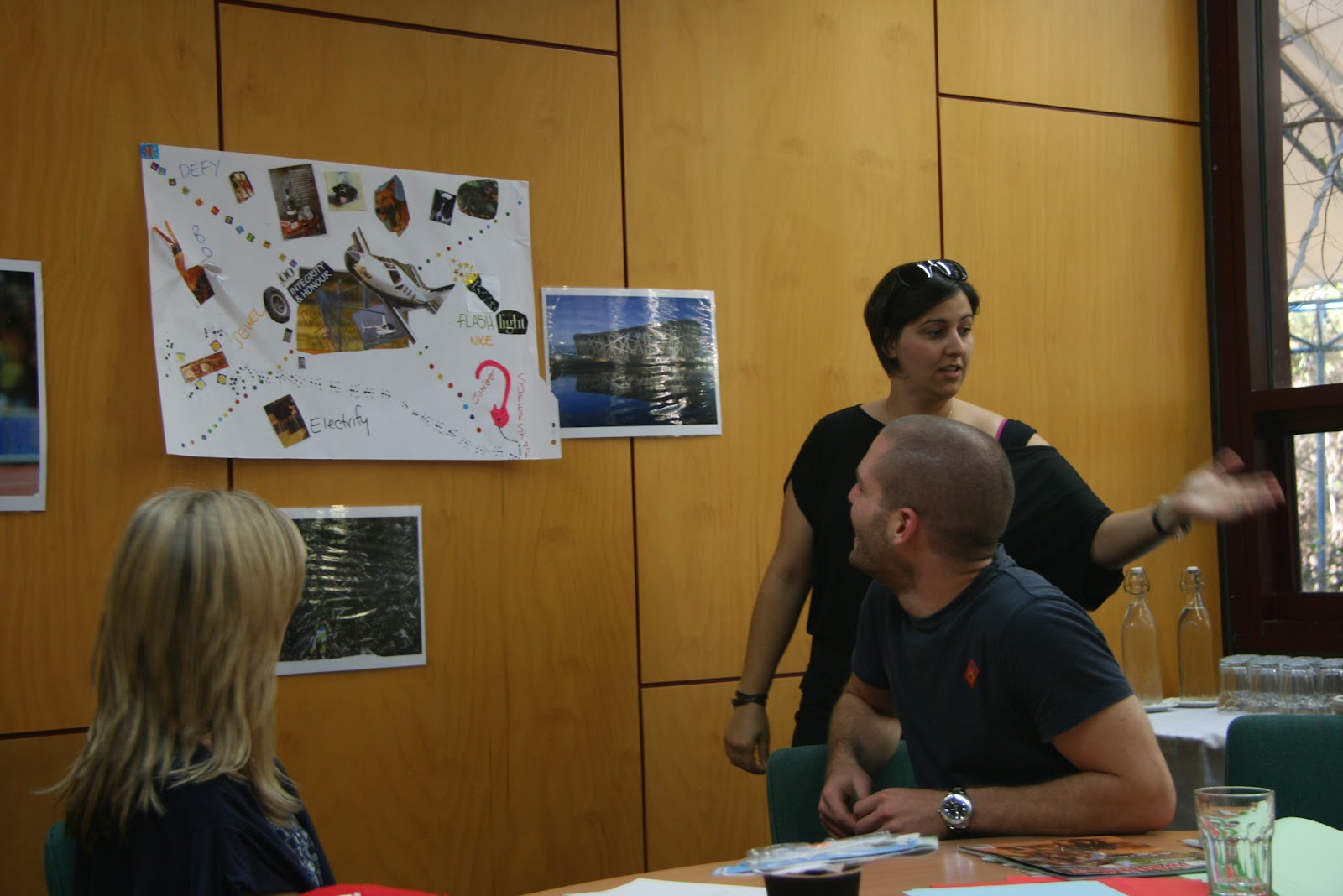
The MCI team has just returned from our incredibly successful team strategic planning event at Fraser Island. It got me thinking about the ingredients that ensured that this event was so successful and why such positive ideas were generated, most of which are practical and can be implemented almost immediately - or at least within 3 - 6 months.
The recipe for strategic planning success:
1. Involve everyone. I am always amazed at how much some team members know and think about, even in areas that are not generally their field of expertise.
2. Fun activities are essential. Play has often been shown to be a key factor in generating creative thinking and innovative solutions so don't be afraid to engage hands-on, minds-on thinking with games and different physical activities.
3. Start by setting out the cold, hard facts. This is very much Jim Collins-type thinking and it does set the parameters of the discussion. There are factors in our environment that are beyond our sphere of influence or control and these have to be laid out clearly at the outset.
4. Set the ground rule: no-one in the room can use the phrase "Yes, But.." Everyone focuses on YES AND thinking. This means that no ideas are bad and even within unworkable ideas, there are grains of thinking that could be transformed in to positive, workable ideas. When team members are working in an environment where no ideas are laughed down, the amount of ideas generated is greater. And the quantity at that stage is important if you are looking for anything of quality to emerge.
5. Set up a theme and preferably something that is competitive. There is nothing that generates more ideas than a spirit of competition....
6. A great venue away from the office and phones and email is also a good idea if possible.
7. Establish clear goals about the reason for the planning session so that there is some form of urgency to the conversation. Demonstrate how these ideas will make the difference to profitability or other success factors.
8. Make sure that you follow up. We have already drafted our action plan and it has been circulated for comments and finalisation.
Please like our facebook page to see more photos from the event.
http://www.facebook.com/pages/Management-Consultancy-International/115635468452415.
Let MCI help you ensure that your strategic planning event does not feel like a waste of time. Make it a worthwhile session that leads to real results!
Monday, May 14, 2012
Major changes to funding arrangements for vocational training
There have been some substantial changes to funding arrangements for traineeships that employers need to be aware of. Whereas in the past there used to be an upfront payment per eligible trainee of $1500, this will no longer be the case. The completion payment of $2500 per person has been changed to $3000 per person.
Here is a link that provides the full explanation:
http://www.australianapprenticeships.gov.au/Budget2012.asp
The implications for business as we see it:
1. If you are in the process of deciding about whether traineeships are appropriate for your team, hasten this process and sign up your trainees before 30 June 2012 so that you fall under the existing arrangements of $4000 per person.
You are able to commence the training through an induction session and the balance of the program can be delivered over the course of the following financial year and beyond if needed.
In this way, you know that you have secured the best financial arrangements for your organisation and will not stand to lose the $1000 that would be the case by signing up later than 30 June.
2. For future trainees, the emphasis will be shifting to ensure that there is a high completion rate of participants. The course will need to be engaging and totally relevant and it does place pressure on providers and on management teams to ensure that groups are applying their skills and accumulating proof of this to submit in their portfolios.
This is an incredibly positive step in that RTO's and organisational stakeholders will be working more closely than ever before to create the right learning environment to enable participants to complete. We foresee the need for more coaches and mentors as well to assist participants to complete their evidence and to provide workplace support.
At the moment, Management Consultancy International has a very high completion rate in dedicated groups with over 90% completions. We do this by offering non-stop support to students where needed and having facilitators who are committed to ensuring the best results possible.
It will be even better when we have more organisational involvement so that we all work towards common goals - more skilled people that are more productive. There are so many research projects proving that a skilled workforce generates more income and higher profitability levels for organisations. Now is the time to ensure that training adds to the organisation's bottom line as well as its positive culture.
3. We also predict that there will be a stronger drive towards on-line and virtual training as organisations seek better, cheaper, faster ways of delivering skills in blended learning environments. Blended learning solutions offer companies a great way for ensuring that skills are learned whilst retaining the high productivity levels that are needed.
Looking at solutions that are not only based on face to face learning, creates the opportunity for organisations to come in under budget AND at the same time reinforce key messages and up-skill teams.
Management Consultancy International has a wide range of options for delivery of programs and we have seen the definite trend towards mixing the learning delivery mechanisms to suit the needs of our clients. We continue to be amazed at the excellent results we are seeing in our groups who are learning virtually - and in fact 2 weeks ago, we held our first virtual graduation of Diploma of Management and Certificate IV in Frontline Management. It certainly sent out a clear message that yes, virtual is a great solution for learning.
4. RPL is going to come through in a more robust way in the future as organisations look to ensuring that participants are recognised for the skills that they do have - without having the time and expense of sending them on training programs that are not needed.
There will be a more targeted approach to training and needs analysis will be done more carefully to ensure that training is properly targeted.
Management Consultancy International already uses an electronic and user-friendly needs analysis process and we are certainly going to need to focus on this more carefully in future.
5. We are also advising our clients to engage with RTO's who are truly education focused and who have the interests of students at heart. There will possibly be a contraction in the RTO space as some providers who have business models based solely on the funding arrangements might fall by the wayside. 'Tick and flick' days are truly over.
Ask your RTO the following questions:
Here is a link that provides the full explanation:
http://www.australianapprenticeships.gov.au/Budget2012.asp
The implications for business as we see it:
1. If you are in the process of deciding about whether traineeships are appropriate for your team, hasten this process and sign up your trainees before 30 June 2012 so that you fall under the existing arrangements of $4000 per person.
You are able to commence the training through an induction session and the balance of the program can be delivered over the course of the following financial year and beyond if needed.
In this way, you know that you have secured the best financial arrangements for your organisation and will not stand to lose the $1000 that would be the case by signing up later than 30 June.
2. For future trainees, the emphasis will be shifting to ensure that there is a high completion rate of participants. The course will need to be engaging and totally relevant and it does place pressure on providers and on management teams to ensure that groups are applying their skills and accumulating proof of this to submit in their portfolios.
This is an incredibly positive step in that RTO's and organisational stakeholders will be working more closely than ever before to create the right learning environment to enable participants to complete. We foresee the need for more coaches and mentors as well to assist participants to complete their evidence and to provide workplace support.
At the moment, Management Consultancy International has a very high completion rate in dedicated groups with over 90% completions. We do this by offering non-stop support to students where needed and having facilitators who are committed to ensuring the best results possible.
It will be even better when we have more organisational involvement so that we all work towards common goals - more skilled people that are more productive. There are so many research projects proving that a skilled workforce generates more income and higher profitability levels for organisations. Now is the time to ensure that training adds to the organisation's bottom line as well as its positive culture.
3. We also predict that there will be a stronger drive towards on-line and virtual training as organisations seek better, cheaper, faster ways of delivering skills in blended learning environments. Blended learning solutions offer companies a great way for ensuring that skills are learned whilst retaining the high productivity levels that are needed.
Looking at solutions that are not only based on face to face learning, creates the opportunity for organisations to come in under budget AND at the same time reinforce key messages and up-skill teams.
Management Consultancy International has a wide range of options for delivery of programs and we have seen the definite trend towards mixing the learning delivery mechanisms to suit the needs of our clients. We continue to be amazed at the excellent results we are seeing in our groups who are learning virtually - and in fact 2 weeks ago, we held our first virtual graduation of Diploma of Management and Certificate IV in Frontline Management. It certainly sent out a clear message that yes, virtual is a great solution for learning.
4. RPL is going to come through in a more robust way in the future as organisations look to ensuring that participants are recognised for the skills that they do have - without having the time and expense of sending them on training programs that are not needed.
There will be a more targeted approach to training and needs analysis will be done more carefully to ensure that training is properly targeted.
Management Consultancy International already uses an electronic and user-friendly needs analysis process and we are certainly going to need to focus on this more carefully in future.
5. We are also advising our clients to engage with RTO's who are truly education focused and who have the interests of students at heart. There will possibly be a contraction in the RTO space as some providers who have business models based solely on the funding arrangements might fall by the wayside. 'Tick and flick' days are truly over.
Ask your RTO the following questions:
- How are they prepared to work with you to ensure high completion rates?
- What type of support is available to ensure that students complete their work - do they have access to materials on-line?
- Do they have a dedicated account manager that will partner with you to ensure that the participants are meeting deadlines and are receiving the type of learning input that they need?
- How will they customise the learning program from a content perspective and from a methodology point of view so that it best suits your organisation?
Wednesday, April 18, 2012
LEGO IDEA Conference, Denmark 2012
What an amazing array of speakers with such interesting perspectives and insights! The LEGO IDEA conference is held each year to emphasise the importance of play - play to learn, play to create and play to innovate.
First speaker was Nicolai
Molkte-Leth, founder of True North Camps, Denmark. He reminded the conference that:
"The greatest danger for most of us is not that we aim
too high and we miss it, but that it is too low and we reach it"
So, out of fear, we
make our goals more average and when they are average, we are not inspired.
We could play life in a higher league. We should be dreaming
of a possible future and when we imagine it,
we can create it.
He encouraged everyone to get out
of the comfort zone. When we hit the
outer wall of the comfort zone, we hit our habits and our beliefs.
But that is where the learning zone is.
If you step too far you get in to panic zone. But you can make a panic zone in to a comfort
zone if you take small steps to reach there.
Highlight for me was Sugata
Mitra, Prof of educational technology at the school of education Newcastle Uni,
UK. Look for him on TED Talks. He spoke about the
future of learning and posed the key statement -
"With
broadband access to google you can pretend to be educated."
He has conducted substantial experiments over the past years to identify why when you live further out from the city, the quality of
education falls dramatically and why when you are in a lower socio-economic category, the quality is also lower.
The hole
in the wall experiment took off. He wanted to explore what
would happen if you give children in a slum a computer. He built a
sort of ATM in the wall of a very poor suburb in India. Children
started to browse on the computer. They did not know English and had never heard of the internet.
Wherever the experiment was tried, children would start playing games. When Prof Mitra returned 9 months, they then asked
for a faster processor and better mouse.
They taught themselves English in order to use the tool. In 9 months, children learnt how to use the
computer according to what an average office worker could do.
Conclusion -
When children have interest, education happens. Groups of
children using the Internet can achieve educational objectives on their own. Children learn best in self
organised learning environments.
How far
can this type,of self organisation go? asked the Prof.
Can they
teach themselves the biotechnology of DNA?
He set up an experiment designed to fail.
He downloaded
information on to the computers about this complex medical topic. He put it in English
and they could not speak English. He pre-tested them and they understood nothing. He left
them for two months.
They did
not give up on it. They in fact went up
30% in terms of knowledge and English use.
In the English system however, they would still have been seen as a failure.
So He sent a
teacher in to tell them how fantastic they are = the grandmother method as they
tell us how wonderful we are.
Scores
jumped to 60 percent .
There is
a way to level the playing fields in richer and poorer areas and the 'granny cloud' system for schools is still used where the granny volunteers are beamed in via skype to disadvantaged communities.
Groups of
children can learn anything by themselves. Provided
they can read and understand what they read and that they know how to believe in their potential.
We need questions
which turn people on. Children work in
a domain where they want relevance.
The curriculum
is seen as uninteresting and irrelevant. Exams are seen as
uninteresting and relevant to get a job.
If your
education system sits in those two boxes, you are doomed to failure.
Children
love the interesting and irrelevant quadrant. Humans
love this. Move education in to that box
and then you have made it. Education
will be something that just happens. How
do we move in to that box? This is where the
future of learning lies!
If we extrapolate this to the adult learning environment, there are also some very useful insights in terms of how we deliver training programs. It places the emphasis far more strongly on groups that are self-organised and that teach themselves.
Mads
Nipper, EVP of
the LEGO group spoke on Cultures
of creativity.
How does
creativity in different cultures work?
The
learning institute has done substantial research in to the future of learning
and also the cultures of learning. The founders of Google played with a lot of bricks that could have inspired them when they were
young.
Technology
is such a huge revolution. Because there is
a digital world, will the physical bricks vanish?
Mads says - No as it is hands on and minds on!
How do we
put all of this creativity in to the global context? Think about the notion of systematic
creativity = Make sense of the world through using the tools of the bricks. They are an
interconnected set of parts. Everyone
can put the bricks together in different ways so that it means something to someone.
There are low entry
levels. Anyone can get started no matter
of cultural background. People know what
to do even if they have never seen a brick before.
The bricks are a medium
for mastery. We never cease to be amazed by
what can be built.
They give us the
ability to create something out of nothing.
The building with bricks supports children in a culture of making things. Most children around the world have nothing.
It has
infinite possibilities. It is about something where you can combine and
integrate ideas.
LEGO provides the belief
in the potential of children and adults and their natural imagination. Playfulness is a basis for cultural
development. The more things that are
playful to express a culture, the better.
There is a belief
in the value of creative play. Dreams
and imagination is important and creative play is an expression of cultural
values.
Playing with LEGO bricks provides an
environment of experimentation. It allows
different ideas to be tried out and experimented with. This in turn encourages a culture of experimenting and
allows for failure. This is universally
valuable.
Play through the bricks grows
with the person and Lego
grows socially beyond the person. It
bridges cultures to empower communities of creativity and collaboration.
Creativity
and play is culture. For all cultures.
Closing keynote was on - The
meaning of innovation. Turning
STEM in to STEAM.
John
Maeda - President Rhode Island School of Design. John is the most brilliant man who has remarkable insights.
"Blast
away at it! Get it done!", William J Mitchell. Don't
think, just make it. Don't think too
hard and just jump in. He said that we live in such a world of VUCA - volatility, uncertainty, complexity and ambiguity. We need the antidote of insight, understanding
and clarity and agility.
We need all kinds
of thinking to help each other. People are
now crossing boundaries all the time - Designers and scientists. We no longer should be thinking out of the box - we need to be thinking at the edge of the box because in that way we can integrate thinking from different spheres
It is up to us to play
well. Have a look at his website - http://stemtosteam.org/ for more insights in to how breakthrough innovation comes from adding art and design to STEM (Science, Technology, Engineering and Math) education and research: STEM + Art = STEAM.
| Jacquie Llyod Smith and LEGO® Legend Kjeld Kirk Kristiansen |
Besides the conference, we were also treated to a fascinating tour of the LEGO museum that stores the organisation's history. LEGO is still a family owned business and has a strong and proud history from humble beginnings as toy makers of wooden toys. There was then the move in to using the plastic moulding machines - but not to create full plastic toys but rather to create bricks that children would use to build their own toys. There were many nay-sayers around 1947 who said that plastic would never be as good as wood.
"Our
strength comes from concentrating on the idea.
Dig deep, range wide - and the ideas will come." Godtfred Kirk Christiansen 1965, second generation owner of Lego.
LEGO has as its mission to "nurture the child in each of us."
LEGO is the only
toy that is always right - because you made it!
The guiding principle of all their production is - only the best is good enough. Is that not a remarkable credo to live by!
Wednesday, March 28, 2012
Extract from Better - Best - Brilliant! Your comprehensive guide to excellence in training delivery
It was a lot of hard work and many late nights - but finally my book, "Better, Best, Brilliant" is on the shelves and shortly will be available in e-book format as well in the Amazon store.
Here is another extract with some straightforward advice on how to use a full range of tools and techniques to ensure that sessions are engaging and that participants know how to apply their skills once they leave the training room.
Tip Number 33:
Whether you work in-house as part of a training or
facilitation team or whether you are in your own consultancy, personal
branding is becoming critically important.
Branding, broadly speaking, is vital to leading
organisations because in a crowded marketplace it is essential
to be on-message and to deliver this message in a consistent way.
Personal branding is about ensuring that people
remember who you are and what you stand for.
Think about personal branding as a way of ensuring
that your training and facilitation stands out from the rest and that you are
the go-to person in the organisation.
Some tips for how to achieve this level of being
able to stand out from the crowd:
·
Make sure that you have an
elevator pitch – this is a your way of introducing yourself to your
colleagues, clients and students. You
need to be able to state in a few words what you are known for and why they
should be talking or listening to you.
Here are some
of the words that I use in my own elevator pitch and I adjust these based on
who I am talking to: “I am Denise and I work for an organisation that cuts
through language and behavioural barriers to get people performing at their
best.” OR “I am Denise and I design
and deliver innovative training for companies wanting their management teams
to function in a cohesive way.”
Think about
these questions when forming your elevator pitch –
1. What is my central purpose?
2. Why do I make an impact on the people I encounter?
3. What differentiates me from the rest?
4. What can I do for others that will resonate with them?
·
We have said it before, but
will repeat it here – first impressions do count, whether you like it or not,
and so ensure that when you are on a face to face basis you are well
presented in terms of your appearance..
nothing sloppy or outrageous, and if you need a make-over, get one
done!
·
Ensure that you have a
positive on-line presence. Often
potential clients or students will have done their research on you and you
need to come across in a professional way.
In order to do this:
1. Conduct an on-line search of your own name on the internet and see
what emerges. We have had had a case
of a trainer who discovered that she had the same name as a criminal and
their name appeared before hers when a search was conducted.
2. Ensure that the way in which you come across is with your
professional background as the number one listing and not a disastrous photo
of yourself at a social event. In
order to achieve this, ensure that you are listed on professional sites such
as Linked In or that you have your own blog which publishes content where you
have expertise. This is irrespective
of whether you are self-employed or work in an organisation.
3. If you choose to be even more pro-active in establishing an
on-line branding, start to use social medial sites such as Twitter to create
an image that is professional and demonstrates that you are an expert. It is also worthwhile in this regard
spending money on a professional photo so that you look at your best.
|
Tip Number 34
Here are some suggestions for maintaining a high
level of quality:
·
Constantly ask for feedback –
I know it is not always easy to accept the feedback but it does push you to
review materials and seek better ways of doing things.
·
If you have access to some
form of advisory board, either in-house or external, it is also worthwhile
meeting to validate your materials, your methodologies and your assessment
tools if you are using these. This
form of validation is often required if you are being formally audited by an
educational authority and is a way of double-checking that you are in fact
delivering to the standards that you promise to your students.
·
Keep an eye on the
competition – there is nothing like working hard to out-do the competitors! It drives your own standards higher and
ensures that you are constantly on your toes.
Set those benchmarks high and you will achieve them in all respects.
·
Mark yourself on some of the
following criteria and keep a log-book of what improvements you are making:
1. How well was the program organised from a logistics point of
view? What could I have done better in
this regard?
2. How well prepared was the group – had they understood the need for
the training and had they arrived at the session, well-motivated and
prepared. What could have been better
at this level of preparation?
3. What could have been done to achieve even better delivery of the
program? Did I tap in to as many tools
and techniques as possible or as appropriate?
What would I do differently next time in order to ensure that change
takes place post-training?
|
Subscribe to:
Posts (Atom)